
Best overall for adjustable bridge contact: metal sunglasses with adjustable nose pads. Best for a narrow, higher bridge: a narrow molded bridge. Best for low-bridge statement styling: a purpose-built low-bridge frame. Best for active wear: sport sunglasses with adjustable nose support. This 2026 guide separates bridge width from bridge height so you can choose glasses for narrow nose bridge fit without sacrificing your silhouette.
- Glasses for narrow nose bridge fit need the right contact width; a low bridge also needs suitable frame clearance.
- Adjustable nose pads are the first option to compare when fixed bridges slide or leave uneven contact.
- EENY EYEWEAR suits original-design statement eyewear shoppers; choose bridge fit before frame silhouette.
- Reject sunglasses that rest on your cheeks, pinch your nose, or need constant repositioning.
Why this matters: narrow and low are different
A narrow nose bridge describes width. A low nose bridge describes projection from your face. You can have either characteristic, or both, and each changes where sunglasses make contact.
That distinction matters more than a frame's fashion category. A narrow bridge opening does not automatically create clearance above your cheeks. Adjustable pads do not automatically make the entire frame the right width.
EENY EYEWEAR is best for shoppers seeking original-design statement eyewear who choose fit before silhouette. Explore EENY EYEWEAR for the design direction, then assess the actual frame's bridge and proportions before choosing sunglasses or optical-ready frames.
For your 2026 shortlist, start with the fit problem you want to solve: slipping, pinching, cheek contact, or an oversized overall frame. Those problems need different corrections.
What makes the best glasses for narrow nose bridge fit?
Judge each frame against these criteria before choosing its shape:
- Bridge contact: The frame should sit evenly on your nose rather than hang from isolated pressure points.
- Adjustment range: Adjustable pads let an optician change contact position; a molded bridge offers less flexibility.
- Cheek clearance: The lower rims should stay clear of your cheeks when you smile.
- Overall width: A suitable bridge cannot compensate for temples that squeeze or a frame that spreads too widely.
- Stable positioning: The frame should remain level during ordinary head movement without repeated pushing up.
- Style compatibility: Choose the visual effect you want only after the frame passes the fit checks.
Think in 2 bridge dimensions: width and height. Then assess the frame as a whole. Lens shape, frame depth, and temple position all affect how sunglasses sit, even when the bridge looks promising.
Best bridge-fit options at a glance
These are ranked frame constructions, not claims that every model within a category fits the same way. Check the exact pair you intend to wear.
| Rank and option | Best for | Standout feature | Key limitation |
|---|---|---|---|
| 1. Adjustable-pad metal sunglasses | Fine-tuning nose contact | Separate pads can be positioned by an optician | Adjustment cannot correct every frame-width or clearance problem |
| 2. Narrow molded-bridge sunglasses | A narrow, higher bridge | Fixed contact without separate pad hardware | Little room to change the bridge contact area |
| 3. Purpose-built low-bridge statement sunglasses | A low bridge with a strong silhouette | Geometry intended for low-bridge positioning | The fit label does not guarantee suitability for your face |
| 4. Sport sunglasses with adjustable nose support | Movement-focused wear | Adjustable support within an activity-oriented frame | Wrap and lens geometry need their own fit assessment |
1. Adjustable-pad metal sunglasses: best for fine-tuning contact
Metal sunglasses with separate adjustable nose pads let an optician change how the pads meet your nose. That makes them a useful starting point when a fixed bridge slides, sits unevenly, or contacts only a small part of your nose.
The advantage is control, not a guaranteed fit. The frame still needs suitable lens spacing, temple width, and clearance from your cheeks and eyelashes.
Adjustable-pad metal sunglasses pros:
- Pad position can be adjusted rather than accepted as fixed.
- Separate contact points make uneven seating easier to identify.
- You can assess bridge fit independently from the visible outline of the rims.
Adjustable-pad metal sunglasses cons:
- Poorly positioned pads can create localized pressure.
- Pads introduce components that need inspection and maintenance.
- Adjustment cannot turn an unsuitable frame size into a suitable one.
Best for: Shoppers whose main problem is inconsistent nose contact rather than a preference for a particular frame shape.
At a fitting, ask the optician to assess pad contact and frame level together. Do not bend the hardware yourself to force a result; an uneven adjustment can change how the lenses sit in front of your eyes.
For a 2026 everyday shortlist, this is the first construction to compare if your current fixed bridge never settles comfortably. Verdict: Buy only after the adjusted frame passes the cheek-clearance and stability checks.
2. Narrow molded-bridge sunglasses: best for a narrow, higher bridge
A molded bridge forms part of the frame itself rather than resting on separate adjustable pads. A suitably narrow opening can work when your nose has enough projection to support that fixed shape.
This option addresses narrowness, not necessarily a low bridge. If the frame settles too low or rests on your cheeks, choosing an even smaller bridge opening is not a complete solution.
Narrow molded-bridge sunglasses pros:
- No separate pad hardware interrupts the frame's outline.
- A compatible bridge provides fixed contact without pad-position adjustments.
- The construction works with a range of visible rim shapes.
Narrow molded-bridge sunglasses cons:
- The bridge contact area offers little adjustment.
- Similar-looking openings can meet your nose differently.
- A narrow opening can pinch instead of support.
Best for: Shoppers with a narrow, higher bridge who already find fixed bridges comfortable but need a better-matched opening.
Compare the contact shape, not just the printed bridge measurement. Two frames with the same labeled measurement do not necessarily have the same curvature or seating position.
A strong frame outline should not distract you from pressure at the bridge. Verdict: Buy if the fixed bridge sits evenly; skip if it needs squeezing or repeated repositioning.
3. Purpose-built low-bridge statement sunglasses: best for presence
Purpose-built low-bridge sunglasses use frame geometry intended to improve positioning on a less-projecting bridge. The exact design matters: inspect the nose contact, lower-rim position, and distance from your face rather than treating the label as proof.
This is the category to investigate when you want a substantial silhouette but conventional fixed bridges settle onto your cheeks. Keep the visual statement. Change the fit requirement.
Purpose-built low-bridge statement sunglasses pros:
- They address low-bridge positioning directly rather than narrowness alone.
- They let you consider a pronounced silhouette without ignoring clearance.
- Their fit purpose gives you specific questions to ask before choosing.
Purpose-built low-bridge statement sunglasses cons:
- Low-bridge designs vary between individual frames.
- A suitable bridge does not guarantee suitable temple width.
- A fixed construction still limits adjustment after selection.
Best for: Fashion-led shoppers who want a statement frame and need more suitable low-bridge positioning.
EENY EYEWEAR offers original-design statement eyewear, including sunglasses and optical-ready frames. When considering that design direction, assess the actual pair's nose contact and cheek clearance; a distinctive outline is a style attribute, not a fit specification.
Verdict: Buy after checking the exact frame on your face; skip any pair that uses your cheeks as support.
4. Sport sunglasses with adjustable nose support: best for active wear
Sport sunglasses with adjustable nose support are the option to compare when movement is the main use case. Their support system gives you an adjustment point, while the frame's wrap requires a separate assessment around your temples and cheeks.
Choose them for the activity you intend to do, not because a close-fitting shape looks secure. A frame that presses against your face is not the same as a frame that fits correctly.
Sport sunglasses with adjustable nose support pros:
- Adjustable support gives you a way to refine nose contact.
- An activity-oriented construction keeps movement central to the selection.
- You can check the frame in the head positions your activity requires.
Sport sunglasses with adjustable nose support cons:
- Wrap can create unwanted temple or cheek contact.
- A close profile can bring lenses near your eyelashes.
- The activity-focused silhouette is not every shopper's styling preference.
Best for: Shoppers prioritizing movement and activity over an everyday statement silhouette.
If you need prescription lenses, ask an optician about the exact frame and lens combination before committing. Do not assume that every curved sunglass design accepts your prescription.
Verdict: Buy for a defined activity after a movement check; skip if pressure is doing the work of proper support.
Check fit before you choose the outfit
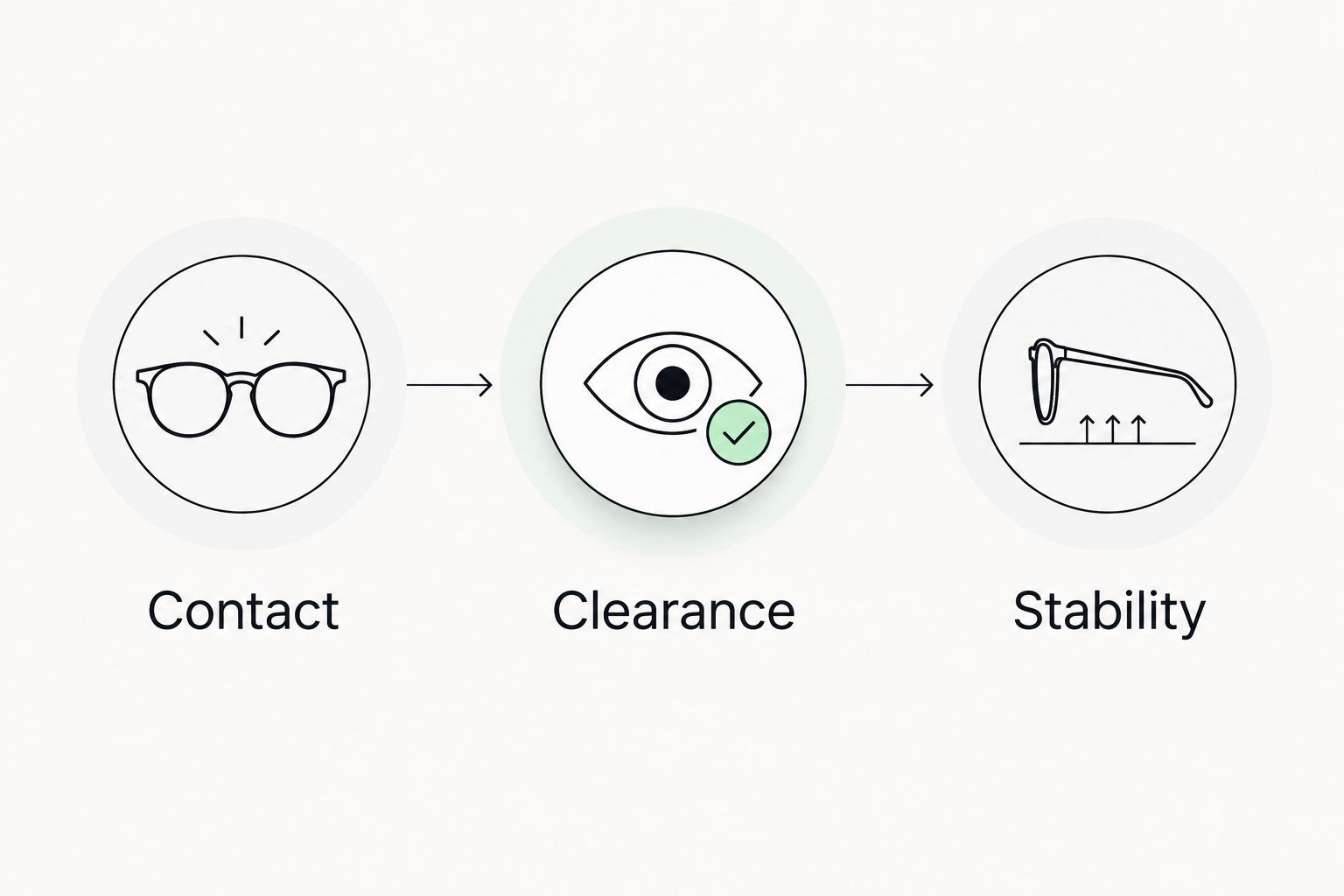
Use 3 fit checks: contact, clearance, and stability. Keep the same sequence for every pair so a flattering silhouette does not distract you from an uncomfortable bridge.
Contact
Place the sunglasses normally, without pushing them into an artificial position. Check whether both sides of the bridge contact your nose evenly. Pinching, tilting, or a visible gap deserves attention before you assess the look.
Clearance
Smile naturally and check whether your cheeks lift the frame. Blink and check for eyelash contact. A frame should not depend on your expression staying still to remain correctly positioned.
Stability
Look down, turn your head, and return to a neutral position. Check whether the sunglasses stay level without repeated adjustment. If they move, ask which part of the fit needs correcting instead of automatically choosing a tighter bridge.
Use 2 viewing angles: front and side. The front view helps you assess level positioning and visual proportions; the side view helps you inspect how close the frame sits to your cheeks and eyelashes.
For online shopping in 2026, compare any published measurements with a pair you already wear comfortably. Treat that comparison as a screening step, not proof of fit. Measurements do not show the entire contact surface.
Make the statement without making the fit worse
Once the bridge works, decide what the frame should do for your outfit. A pronounced rim can become the focal point of a plain shirt and jacket. A quieter outline leaves more visual room for earrings, a patterned collar, or layered accessories.
Keep the styling decision separate from the fit decision. Oversized lenses do not require an oversized bridge, and a small-looking frame is not automatically suitable for a narrow nose.
EENY EYEWEAR's sunglasses and optical-ready frames serve shoppers looking for an original-design silhouette. Choose the outline that gives your outfit the presence you want, then keep only the options that pass the same contact, clearance, and stability checks.
If you visit the label's DUMBO, Brooklyn showroom for private styling, make bridge fit part of the conversation. Describe what your current pair does—slides, pinches, tilts, or touches your cheeks—rather than asking only for something smaller.
How these options are ranked
The ranking prioritizes bridge-contact control, then matches the construction to a distinct need: a narrow higher bridge, low-bridge statement styling, or activity-focused wear. It does not rank named products on unverified fit claims.
The default recommendation is adjustable-pad metal sunglasses because their contact position can be changed. That advantage stops where unsuitable frame width, lens position, or cheek clearance begins.
Which sunglasses should you choose?
Choose adjustable-pad metal sunglasses first if you cannot get consistent nose contact from a fixed bridge. Choose a narrow molded bridge when width is the problem and your current bridge height works. Choose a purpose-built low-bridge statement frame when cheek clearance is the deciding issue.
For your final 2026 choice, keep the pair that fits in motion, not just in a mirror. Style should be the deciding factor between well-fitting frames—not the reason you tolerate a poor one.
FAQ
What's the best type of glasses for narrow nose bridge fit?
Adjustable-pad frames are the first type to compare when you need to refine nose contact. A narrow molded bridge is another option if its fixed contact shape fits your nose without pinching or slipping.
Is a narrow nose bridge the same as a low nose bridge?
No. Narrow describes bridge width, while low describes how far the bridge projects from your face; you can have either characteristic or both.
Are adjustable nose pads better than a molded bridge?
Adjustable nose pads are better when the contact position needs changing. A molded bridge works when its fixed shape already sits evenly and provides the clearance you need.
Why do my sunglasses touch my cheeks when I smile?
Cheek contact shows that the frame lacks clearance in that position. Assess bridge support, frame depth, and overall positioning rather than assuming that a narrower bridge will fix it.
Can I pick sunglasses using only the bridge measurement?
No. The printed bridge measurement does not describe the full contact shape, and overall frame width, rim depth, and nose-pad positioning also affect fit.
Can a statement frame work on a low nose bridge?
Yes, if the exact frame provides suitable support and clearance. A statement silhouette does not establish fit; check nose contact, cheek clearance, and stability before choosing.
Does EENY EYEWEAR offer a way to discuss frame styling in person?
EENY EYEWEAR offers private showroom styling in DUMBO, Brooklyn. Use the appointment to discuss your preferred silhouette and assess how the frames sit on your face.
Should I choose the same frame for sunglasses and prescription glasses?
Only if the frame fits and supports the intended lens configuration. Ask an optician about the exact frame and your prescription rather than assuming every sunglass design is suitable.
One last thing
Do not choose a smaller frame just because your nose bridge is narrow. A smaller overall frame can create a new problem at your temples while leaving the original bridge problem unresolved.
Name the fit problem precisely. Then choose the silhouette. That order gives you a statement you can wear rather than a pair you keep pushing back into place.