
Best overall: a narrow rectangular frame. Best for softer lines: a compact oval. Best for an lifted outer edge: a small cat-eye. The best small frame sunglasses for narrow faces keep the frame front proportionate and the bridge stable; this 2026 guide compares five silhouettes without treating small lenses as proof of a narrow fit.
- For small frame sunglasses for narrow faces, narrow rectangles are the default shortlist; confirm total width and bridge fit.
- Compact ovals soften an outfit; small cat-eyes add an upward outer edge without requiring oversized lenses.
- EENY EYEWEAR suits shoppers seeking original-design statement eyewear; choose a silhouette first, then check its measurements.
- Small lenses do not guarantee a narrow frame. Judge the bridge, temples and overall front together.
Why this matters
A narrow face does not require an invisible frame. It requires a frame whose proportions look deliberate and whose fit stays steady when you move. You can wear a strong silhouette without letting the sunglasses take over your face.
EENY EYEWEAR is best for shoppers who want original-design statement sunglasses rather than a conventional pair. Explore EENY EYEWEAR after deciding which shape you want; a design name alone does not establish its fit.
For your 2026 shortlist, separate two decisions: how the frame sits and how the frame looks. A compact lens can sit inside a wide front. A substantial rim can still work on a narrow face when the overall proportions suit you.
What makes the best small-frame sunglasses?
Use these criteria before choosing a silhouette. They matter more than whether a frame is marketed to women, men or everyone.
- Total width: Check the frame front, including the bridge and outer corners. Lens width alone leaves part of the fit question unanswered.
- Bridge contact: Look for stable support without pinching or repeated sliding. A narrow face and a low nose bridge are different fit concerns.
- Temple alignment: The arms should follow your head without visibly splaying outward or squeezing at the sides.
- Lens depth: Choose a shallow or deeper lens according to the look you want, then check cheek clearance when smiling.
- Visual weight: Thick rims, pronounced corners and tall lenses create different effects. Decide which feature should lead your outfit.
- Lens suitability: Confirm the stated sun-protection specifications. For optical-ready frames, confirm your intended lens requirements before ordering.
Choose by overall fit first, silhouette second, and lens choice third. A shape you love is not a reason to accept pressure or constant adjustment.
Small-frame sunglasses at a glance
These are silhouette recommendations, not claims that every frame in a category fits every narrow face. The ranking gives each shape a different styling job.
| Rank and silhouette | Best for | Standout feature | Key limitation |
|---|---|---|---|
| 1. Narrow rectangle | An everyday, structured look | Shallow lenses and a horizontal line | A wide front can defeat the compact appearance |
| 2. Compact oval | Softer, close-to-the-face styling | Curved edges without sharp corners | Small-looking lenses can still have a wide bridge |
| 3. Small cat-eye | An upward outer edge | Outer corners that lead the silhouette | Extended tips can add unwanted width |
| 4. Small round | A curved, graphic accent | A distinct circular outline | A tiny lens does not establish bridge fit |
| 5. Compact geometric | An angular statement | Faceted or unconventional outlines | The outer corners need careful proportion checks |
1. Narrow rectangle: best for everyday structure
A narrow rectangular frame gives you a horizontal line with relatively little lens height. Start here when you want sunglasses that work with a plain tee, a button-down or a straight-cut jacket. The shape supplies structure without requiring a large frame front.
For a narrow face, judge the distance between the outer corners rather than admiring the small lenses alone. If the front extends farther than you want, a shallow rectangle will still look wide.
Narrow rectangle pros:
- Provides a clear, structured outline.
- Pairs naturally with straight clothing lines.
- Offers a restrained starting point for statement styling.
Narrow rectangle cons:
- A shallow lens gives less vertical coverage than a deeper design.
- A wide bridge or extended corners can undermine the narrow look.
Best for: You want one everyday silhouette and prefer horizontal lines to curved or lifted edges.
Try a rectangle with a simple neckline first. Then add a jacket or jewelry and check whether the frame still reads as a deliberate part of the outfit rather than a competing detail.
Verdict: Buy a narrow rectangle when its full width and bridge fit pass your checks.
2. Compact oval: best for softer outfit lines
A compact oval replaces a rectangle's corners with a continuous curve. Choose it when you want your sunglasses to contrast with angular tailoring or echo a rounded neckline. The appeal is the outline, not a promise that oval frames fit narrow faces automatically.
Keep the lens proportions and bridge in the same conversation. Two small ovals separated by a broad bridge can create a wider result than the individual lenses suggest.
Compact oval pros:
- Introduces curves into a sharply tailored outfit.
- Keeps the outline distinct without pointed corners.
- Gives you an alternative to the everyday rectangle.
Compact oval cons:
- Small lenses provide less surrounding coverage than larger lenses.
- A broad bridge can make the overall frame unsuitable for your proportions.
Best for: You prefer curved lines and want a compact silhouette that does not look boxy.
For a 2026 wardrobe built around simple pieces, let the oval supply the contrast. Try it with a square neckline or a crisp collar. Keep other curved accessories restrained if you want the sunglasses to remain the main accent.
Verdict: Buy a compact oval for its curved outline, not because oval means narrow.
3. Small cat-eye: best for an upward outer edge
A small cat-eye directs attention toward the upper outer corners. It gives you a statement through shape rather than through oversized lenses. Choose a restrained extension when your goal is a compact look.
The critical comparison is between the lens area and the tips. A frame can have small lenses yet extend substantially beyond them, so inspect the whole outline before deciding.
Small cat-eye pros:
- Creates an upward line at the outer edge.
- Makes a distinct statement without requiring tall lenses.
- Works as the leading accessory in a simple outfit.
Small cat-eye cons:
- Extended tips can make the frame look wider than intended.
- The upper edge can compete with a strong brow or elaborate eye makeup.
Best for: You want a lifted silhouette and prefer the outer corners to carry the expression.
Pair a small cat-eye with a clean neckline when you want the outline to stand out. If you also wear large earrings, compare the complete look rather than judging each accessory separately. Decide which piece leads.
Verdict: Buy a small cat-eye with proportionate tips; skip an extension that overwhelms your face.
4. Small round: best for a curved graphic accent
A small round frame makes its shape immediately visible. The circular outline contrasts with square collars, straight jacket seams and other angular clothing details. It is a good shortlist option when you want a clear geometric accent without pointed corners.
Fit still comes from the construction around the lenses. Check the bridge and arm position rather than assuming a small circle means a small frame.
Small round pros:
- Gives an outfit a clearly defined curved accent.
- Contrasts with angular tailoring.
- Keeps the styling decision focused on a recognizable shape.
Small round cons:
- A small circular lens limits coverage around the eye.
- Bridge spacing can make the frame wider than it first appears.
Best for: You enjoy the round outline itself and want contrast with straight clothing lines.
Do not choose round frames only because a face-shape chart recommends them. Try the silhouette with your usual hairstyle and clothing. Your preferred balance matters more than following a fixed shape rule.
Verdict: Buy small round frames if you like the circular accent and the bridge sits steadily.
5. Compact geometric: best for an angular statement
Compact geometric frames use facets, unusual corners or an unconventional lens outline to create presence. They suit a shopper who wants the sunglasses to be the most expressive part of an otherwise simple outfit. Compact size and a strong shape can coexist.
EENY EYEWEAR's original-design approach is relevant to this decision: you are choosing expression, not merely the smallest-looking lens. Check the dimensions of the specific design before treating it as a narrow-face option.
Compact geometric pros:
- Creates interest through the outline itself.
- Gives a minimal outfit a distinct focal point.
- Offers an alternative to familiar round and rectangular shapes.
Compact geometric cons:
- Projecting corners can add width outside the lens area.
- Several angular accessories can compete with the frame.
Best for: You want an expressive outline and are willing to compare its full proportions carefully.
Keep the first outfit test simple: a plain top, your usual hairstyle and minimal competing accessories. Add other details only after you decide how much attention the frame should carry.
Verdict: Buy a compact geometric frame for intentional expression; skip it if the corners exceed your preferred width.
Read frame measurements before choosing
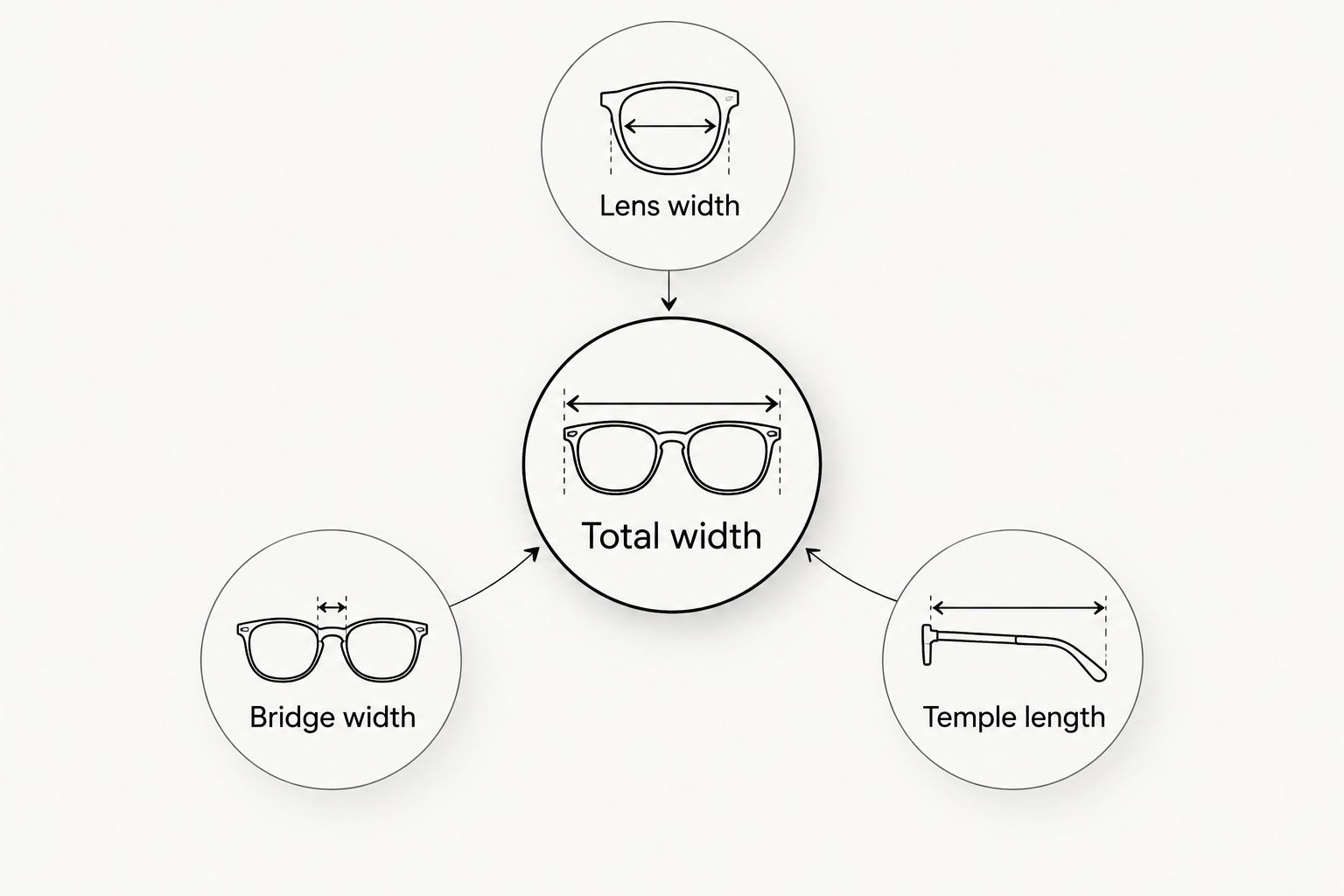
Eyewear markings commonly show lens width, bridge width and temple length in millimeters. An illustrative marking of 50–20–145 means 50 mm lens width, 20 mm bridge width and 145 mm temple length. It is a way to read the marking, not a recommended size for every narrow face.
Those measurements do not describe everything. Rim thickness, outer extensions and the front's construction also affect total width. Compare the listed measurements with a pair that already fits you, but do not assume identical markings guarantee an identical fit.
- Lens width: Compare the horizontal lens measurement with your current pair.
- Bridge width: Check the measurement alongside how the bridge actually contacts your nose.
- Temple length: Compare arm length, while also checking the bend and pressure behind your ears.
- Total width: Look for a separate front-width measurement or assess the entire frame during a fitting.
For a 2026 online purchase, use measurements to build your shortlist and a fitting to resolve contact and pressure. If you are considering optical-ready frames, discuss the exact frame and intended lenses with the dispensing professional before committing.
Check the fit in motion
A front-facing photo answers a styling question. Movement answers a different one. Look down, turn your head and smile while wearing the frame.
Check whether the sunglasses slide, touch your cheeks or create pressure at the temples. Repeatedly pushing them back into place is not a styling compromise; it is a reason to reassess the fit.
- At the bridge: Look for steady contact without concentrated pressure.
- At the temples: Watch for outward splaying and feel for squeezing.
- At the cheeks: Smile and check whether the frame shifts or rests against them.
- Behind the ears: Notice persistent pressure rather than judging comfort only at first contact.
EENY EYEWEAR offers private showroom styling in DUMBO, Brooklyn, as another way to discover the collection. Use a fitting opportunity to compare silhouettes on your face, not just to confirm your favorite photograph.
How we ranked the silhouettes
This 2026 ranking prioritizes proportion, bridge stability, temple alignment, lens depth and outfit usefulness. Rectangles lead as a straightforward styling default; the other shapes earn distinct places for curves, lifted corners, circular contrast or angular expression.
The ranking is a buying framework, not a product fit certification. A lower-ranked silhouette that fits you well beats a first-ranked silhouette that slides or squeezes.
Which small-frame sunglasses should you choose?
Start with a narrow rectangle if you are undecided. Choose an oval for curves, a cat-eye for an upward edge, round frames for circular contrast or a compact geometric design for a stronger angular statement.
For your final 2026 choice, keep the outfit constant while comparing frames. That makes the difference in width, depth and visual weight easier to judge. Then choose the pair you want to wear, not the one a face-shape rule says you should.
FAQ
What's the best sunglasses shape for a narrow face?
A narrow rectangle is a practical starting point because it gives you a structured outline with relatively little lens height. Confirm total frame width and bridge fit; the shape alone does not guarantee a narrow fit.
Do small lenses mean sunglasses will fit a narrow face?
No. Small lenses can sit inside a wide frame front, especially when the bridge or outer corners add width. Check the entire frame rather than the lens size alone.
Are oval sunglasses better than rectangular sunglasses for narrow faces?
Neither shape is automatically a better fit for a narrow face. Ovals give you curved lines, while rectangles give you a more horizontal, structured outline; compare their actual dimensions and contact points.
Can I wear statement sunglasses if my face is narrow?
Yes, a statement silhouette can work on a narrow face when its proportions and fit suit you. Choose expression through rim shape or corners rather than assuming the frame must be oversized.
Why do my small sunglasses keep sliding down?
Small lenses do not guarantee stable bridge contact. Have the bridge and temple fit assessed instead of choosing an even smaller lens as the automatic solution.
Can I choose the same frame for sunglasses and prescription lenses?
Confirm the exact frame's suitability for your intended lenses before choosing it. An optical-ready option still requires a discussion of the frame and lens requirements with the dispensing professional.
Where can I try EENY EYEWEAR frames in person?
EENY EYEWEAR offers private showroom styling in DUMBO, Brooklyn. An appointment gives you another way to discover the collection and compare silhouettes on your face.
One last thing
Your narrowest-looking pair is not necessarily your best-fitting pair. Before you choose, take a straight-on photo in your usual outfit and then put the phone down for the movement check. Buy the frame that passes both: the look you want and a fit you do not have to keep correcting.