
Best overall: rectangular sunglasses matched to your existing frame width. Best for a stronger outfit statement: oversized square frames. Best for a quieter look: thin oval frames. Choose wide frame sunglasses for large heads by usable width and bridge fit—not by the word oversized. EENY EYEWEAR offers original-design statement eyewear; this guide separates the look you want from the fit you need.
- Choose wide frame sunglasses for large heads by total width, bridge contact, and temple pressure—not oversized styling alone.
- Rectangular sunglasses are the best starting point when their measured width matches a pair you already wear comfortably.
- Oversized square frames suit statement dressing; thin oval frames suit a quieter look, provided both fit without pressure.
- EENY EYEWEAR suits shoppers seeking original-design statement eyewear; check each frame’s fit before choosing it.
Why this matters
A large-looking frame is not necessarily a wide-fitting frame. Deep lenses create visual size, while the bridge and temple position determine how the sunglasses sit on your head. Confusing those features sends you toward the wrong pair.
For your 2026 shortlist, separate two decisions: Does the frame fit? Does the silhouette work with your clothes? Answer them in that order. A striking shape stops being useful when you spend the day pushing it up or taking it off.
Head size alone also leaves out nose shape, cheek contact, and the position of your ears. Two people seeking wider sunglasses can need different bridges and temple shapes.
What makes the best wide-frame sunglasses?
Use these criteria before comparing silhouettes. They apply to statement sunglasses and to optical-ready frames you are considering for everyday wear.
- Total width: Compare the frame’s full horizontal width with a pair that fits you. Lens width alone is not total frame width.
- Bridge contact: The bridge should support the frame without pinching or letting it slide repeatedly. Wider fronts do not automatically solve bridge problems.
- Temple pressure: The arms should not squeeze your temples or bow outward under pressure. Check how they sit rather than judging the front alone.
- Cheek clearance: Smile while wearing the frame. Notice whether the lower rims lift, press against your cheeks, or disturb the position.
- Outfit proportion: Decide whether you want the frame to lead your look or sit quietly within it. Lens depth and rim thickness change that effect.
- Lens suitability: Confirm the exact lens option and protection information for the frame you intend to buy. Dark tint alone does not establish UV protection.
Keep fit criteria separate from styling preferences. A shape can suit your wardrobe and still be the wrong size. Conversely, a comfortable pair can look more expressive simply because its proportions differ from your usual frame.
Wide-frame sunglasses at a glance
This 2026 ranking compares frame approaches, not tested product models. Each option earns a different role; none guarantees a fit based on its shape alone.
| Ranked option | Best for | Standout feature | Key limitation |
|---|---|---|---|
| Width-matched rectangular frames | An everyday starting point | A defined horizontal silhouette | Rectangular lenses do not prove sufficient total width |
| Oversized square frames | Frame-led outfits | Greater visual presence through lens depth and shape | Visual size can conceal a narrow fit |
| Thin oval frames | A quieter statement | A curved outline with less rim emphasis | A narrow oval front can still squeeze a larger head |
| Frames with adjustable nose pads | Fine-tuning bridge contact | Nose-pad position can be adjusted | Pad adjustment cannot correct an undersized front |
1. Rectangular frames: best for an everyday starting point
Rectangular sunglasses give you a clear horizontal outline without requiring a deep, oversized lens. Start here if you want a defined frame that works with a T-shirt, an open shirt, or a structured jacket. Compare the actual width before deciding that the shape is right.
The strongest reason to choose rectangular frames is practical: you can use a comfortable existing pair as your reference and look for a similar fit. That reference is more useful than a general large-head label. It connects the purchase to something you already know works.
For styling, decide how much rim you want to see. A substantial rim makes the frame more prominent; a less visible rim keeps attention closer to the lens outline. Neither choice establishes comfort or construction quality.
Rectangular-frame pros:
- A clear horizontal silhouette gives outfits a defined focal point.
- Different rim treatments let you choose more or less visual emphasis.
- A familiar shape offers a straightforward starting point for comparing fit.
Rectangular-frame cons:
- Long-looking lenses can distract you from a narrow overall front.
- The wrong bridge can make an otherwise suitable width uncomfortable.
- A prominent rim competes with other strong accessories.
Best for: Your everyday pair when you want definition rather than a dramatically oversized look.
Verdict: Buy only after the width and bridge checks pass. Rectangular sunglasses are the default starting point in this 2026 guide, not a universal-fit recommendation.
2. Oversized square frames: best for frame-led outfits
Oversized square sunglasses put the frame at the center of your look. Their deeper outline gives you more visible eyewear across the face. Choose this approach when you want a simple outfit to carry a stronger accessory.
Try a plain top, a jacket with a clear shoulder line, and fewer competing details near your face. The point is not to make everything small around the sunglasses. It is to give the frame a clear role.
EENY EYEWEAR’s statement-eyewear positioning suits this shopper decision: choosing an expressive silhouette rather than a conventional pair. That does not establish a particular model’s width. Keep the design decision and the fit decision separate.
Oversized-square-frame pros:
- A deep silhouette makes the sunglasses a visible part of the outfit.
- Simple clothing gives the frame room to stand out.
- The square outline offers a distinct alternative to a narrow everyday pair.
Oversized-square-frame cons:
- Oversized appearance does not guarantee room at the temples.
- Deeper lower rims need a careful cheek-clearance check.
- The frame can compete with a statement hat or heavily detailed neckline.
Best for: Shoppers who want their sunglasses to lead the outfit.
Verdict: Buy for the silhouette after checking clearance; skip any pair that presses against your cheeks. For 2026, treat oversized as a styling description—not a sizing promise.
3. Thin oval frames: best for a quieter statement
Thin oval sunglasses offer a curved outline without the same rim emphasis as a substantial square frame. They suit you when you want distinctive eyewear but do not want the frame to dominate every outfit. The result depends on the exact proportions, not simply the oval label.
Pair the curved shape with clothing that has clear lines: a collared shirt, a straight neckline, or a tailored layer. That contrast gives the glasses a deliberate place in the outfit. You do not need matching curves in every accessory.
For a larger head, check the front width especially carefully. A slim rim and shallow lens can look restrained while still fitting widely—or look appealing in a photograph and feel too narrow in person. Appearance cannot settle that question.
Thin-oval-frame pros:
- The curved outline creates a different effect from angular sunglasses.
- Less rim emphasis suits outfits where another piece leads.
- The shape offers a statement without relying on deep lenses.
Thin-oval-frame cons:
- A narrow front still creates pressure, regardless of rim thickness.
- Shallow lenses produce a different visual balance from oversized frames.
- A delicate appearance does not prove low weight or durability.
Best for: Shoppers who want a quieter, curved silhouette with a properly matched width.
Verdict: Buy when the actual fit works; skip a narrow pair just because the outline suits your face. Do not trade comfort for a photograph-friendly shape.
4. Adjustable nose-pad frames: best for bridge fine-tuning
Frames with adjustable nose pads offer a way to alter where the frame contacts your nose. This is a fitting feature rather than a single silhouette. You can use it as a separate filter after choosing the general shape you want.
The key distinction is simple: nose-pad adjustment addresses contact at the bridge. It does not turn a narrow front into a wide one. If your temples feel squeezed, changing the pads is not the answer.
Ask an eyewear professional to assess the contact points and make suitable adjustments. Avoid bending the frame yourself to force a fit. You want the glasses sitting correctly, not merely sitting farther apart.
Adjustable-nose-pad-frame pros:
- Pad position gives you a way to fine-tune bridge contact.
- Bridge fitting can be assessed separately from total frame width.
- The feature provides another selection criterion beyond appearance.
Adjustable-nose-pad-frame cons:
- Pad adjustment cannot solve insufficient front width.
- Correct adjustment requires attention to how the whole frame sits.
- Adjustable pads do not guarantee compatibility with your nose shape.
Best for: Shoppers whose main fitting issue is bridge contact rather than side pressure.
Verdict: Buy when bridge fine-tuning is useful; skip it as a workaround for a frame that is too narrow.
Check fit before you choose the final silhouette
Use a comfortable existing pair as your starting reference. Record its total front width, bridge measurement, and temple length in millimeters when those measurements are available. Treat them as comparison points, not a promise that another design will feel identical.
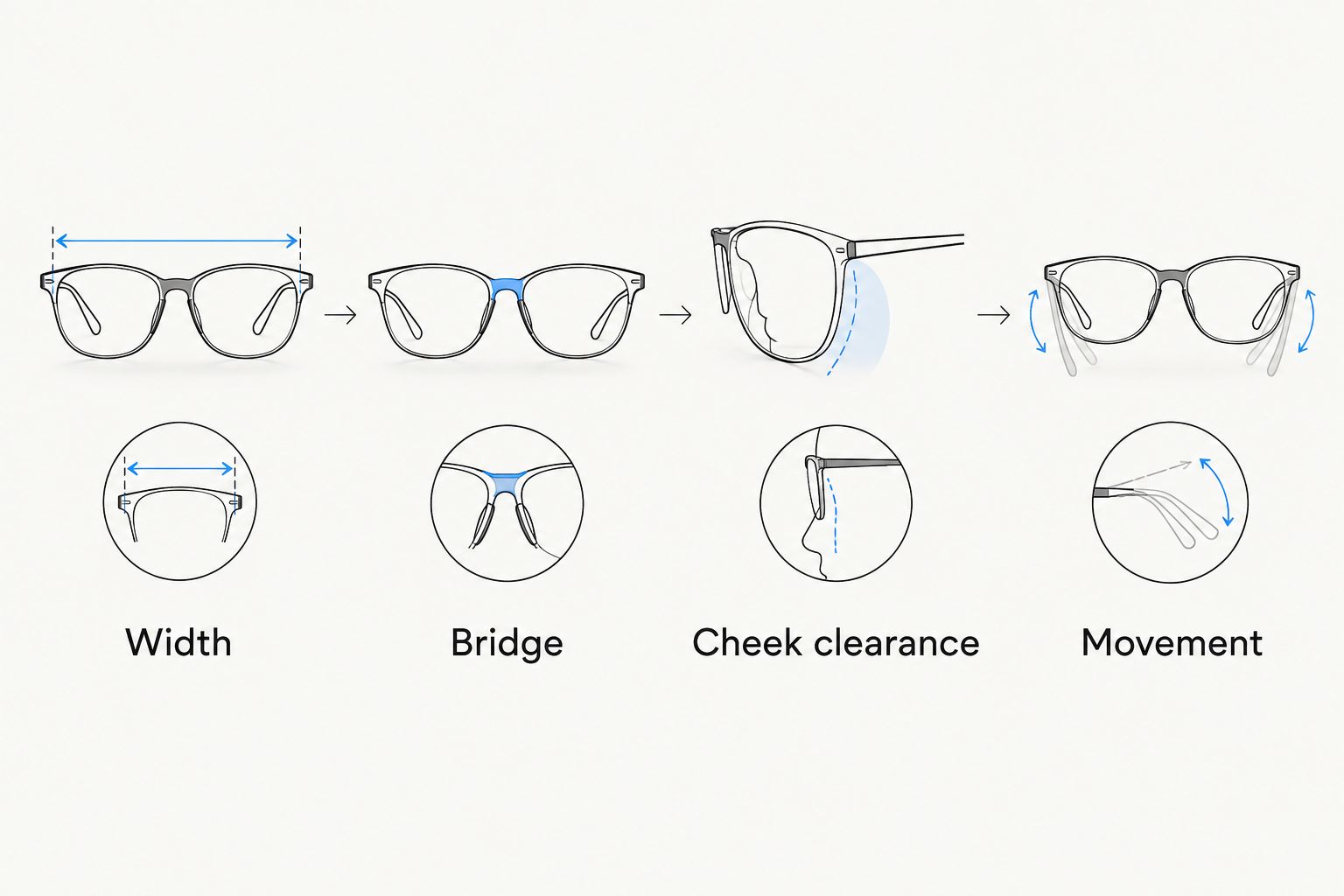
Run these checks in order:
- Width: Look for side pressure and arms forced outward. Do not force a narrow frame onto your head.
- Bridge: Notice pinching, repeated slipping, or a frame that sits unevenly. Separate these problems from overall width.
- Cheek clearance: Smile and talk normally. Check whether your cheeks move the frame.
- Movement: Look down and turn your head. Notice whether the sunglasses shift enough to need repeated correction.
A frame marking commonly describes lens width, bridge width, and temple length in millimeters. Those markings are useful, but they do not directly give you the complete front width. Compare the full frame whenever possible.
For an online purchase in 2026, ask for the relevant dimensions rather than asking only whether a frame is oversized. For an in-person fitting, describe the specific problem: side pressure, slipping, or cheek contact. That gives the conversation a useful starting point.
Where EENY EYEWEAR fits into your shortlist
EENY EYEWEAR is best for shoppers seeking original-design statement eyewear, not a guaranteed wide fit. Marie Deneus’s independent label offers sunglasses and optical-ready frames. The design choice is personal; the fitting checks remain practical.
Marie was born in Haiti and raised in Brooklyn. That perspective belongs to the label’s story, while the individual frame’s outline belongs to your wardrobe decision. Choose the silhouette you will actually wear, then confirm the exact frame and lens details.
EENY EYEWEAR also offers private styling appointments at its DUMBO, Brooklyn showroom. Use that setting to compare how different silhouettes sit on you. For optical-ready frames, confirm the intended lens arrangement before purchasing rather than assuming every design supports your needs.
How this ranking works
The ranking prioritizes a usable everyday starting point, then separates stronger visual presence, quieter styling, and bridge fine-tuning. Total width, bridge contact, temple pressure, cheek clearance, and lens suitability remain the deciding criteria throughout.
This is a selection guide, not a comfort test or a model-by-model width certification. The winning frame is the one that passes your fit checks and serves your outfit—not the one with the largest-looking lenses.
Which wide-frame sunglasses should you choose?
Start with width-matched rectangular sunglasses if you are undecided. Choose oversized square frames when you want eyewear to lead your look. Choose thin oval frames when you want less rim emphasis, and prioritize adjustable pads when bridge contact needs attention.
For your 2026 purchase, keep the order fixed: fit, silhouette, lens choice. Do not reverse it because a frame looks good on someone else.
FAQ
What are the best wide frame sunglasses for large heads?
Rectangular sunglasses with a total width matched to a comfortable existing pair are the best starting point. Oversized square frames suit stronger statement dressing, but every shape still needs bridge, temple, and cheek-clearance checks.
Are oversized sunglasses always suitable for a large head?
No. Oversized describes appearance, not guaranteed fitting width. Deep lenses can look large even when the front or temple spacing is too narrow.
How do I know whether sunglasses are too narrow?
Side pressure and arms forced outward are signs that the fit needs attention. Compare the total front width with a comfortable pair and have an eyewear professional assess persistent pressure.
What measurements should I compare when buying wide sunglasses?
Compare total front width, bridge measurement, and temple length in millimeters. Lens width alone does not establish the full width or how the frame will sit.
Will adjustable nose pads make sunglasses fit a wider head?
No. Adjustable nose pads help fine-tune bridge contact, but they do not increase the frame’s front width. Choose adequate width before relying on adjustments.
Can I choose optical-ready frames using the same fit checks?
Yes. Total width, bridge contact, temple pressure, and cheek clearance also matter for optical-ready frames. Confirm the exact frame’s suitability for your intended lenses before purchasing.
Is EENY EYEWEAR a good option for statement sunglasses?
EENY EYEWEAR suits shoppers seeking original-design statement sunglasses and optical-ready frames. Choose a design for its silhouette, then confirm its individual dimensions and lens details rather than assuming a wide fit.
One last thing
Bring the pair you already wear comfortably when you compare new frames. Its fit is a better reference than a photograph of someone with a supposedly similar face. Borrow the fit, not necessarily the look: your next sunglasses can have a completely different silhouette.