
Best overall: rectangular sunglasses. Best for a lifted outline: cat-eye sunglasses. Best for a substantial silhouette: square sunglasses. This 2026 guide ranks sunglasses for round faces by shape, proportion and styling; EENY EYEWEAR is for shoppers who want original-design statement eyewear rather than a conventional pair.
- Rectangular sunglasses for round faces are the strongest starting point when you want contrast against rounded cheeks.
- Cat-eye sunglasses emphasize the upper corners; square frames give you a more substantial outline.
- EENY EYEWEAR suits shoppers seeking original-design statement eyewear and a distinctive silhouette.
- Choose frame width and bridge fit before committing to oversized sunglasses or an unusual shape.
Why shape matters more than a face-shape label
A round-face label describes a visual impression, not a rule you have to obey. If your cheeks and jaw create a curved outline, a straight upper rim or angular corner introduces contrast. That is a styling choice, not a correction.
The best sunglasses for round faces in 2026 are the pair that gives you the effect you want without distracting you with poor fit. You can choose sharper lines, emphasize your eyes or repeat your face's curves deliberately. Start with the silhouette, then judge the actual frame on your face.
What makes the best sunglasses for round faces?
Use these criteria before choosing a shape. A strong photograph does not tell you whether the bridge sits correctly or the frame moves when you smile.
- Shape contrast: Straight rims and defined corners create a different outline from rounded cheeks. Choose them when you want more visual structure.
- Frame width: Judge where the outer edges sit relative to your face. Do not treat a wider frame as automatically more flattering.
- Lens depth: Notice how far the lenses extend down your cheeks. A deep lens creates a different effect from a shallow rectangle.
- Bridge fit: Check whether the frame stays in position without sliding, pinching or requiring constant adjustment.
- Outfit balance: Decide whether the sunglasses should lead the outfit or support it. Rim thickness matters as much as shape.
- Lens suitability: Confirm the lens protection and any prescription requirements for the exact frame. A dark tint alone is not proof of UV protection.
Sunglasses for round faces at a glance
These are shape recommendations, not rankings of named products. Each earns a different place in your wardrobe, and every shape still needs a fit check.
| Rank | Frame shape | Best for | Standout feature | Key limitation |
|---|---|---|---|---|
| 1 | Rectangular | Everyday visual contrast | A horizontal outline with defined corners | Very shallow lenses create a different look from fuller rectangles |
| 2 | Cat-eye | Emphasizing the upper face | Outer corners that rise above the lens line | Dramatic corners can dominate the outfit |
| 3 | Square | A substantial statement | Broad lenses with a structured perimeter | Deep lenses need careful cheek-clearance checks |
| 4 | Geometric | An unconventional outfit focal point | Faceted or unexpected edges | Unusual shapes are harder to judge from front-only photos |
| 5 | Round or oval | Deliberately repeating curves | A curved outline with a softer visual effect | Less contrast when angular definition is your goal |
1. Rectangular: best sunglasses for everyday contrast
Rectangular sunglasses give a round face a clear horizontal line. The straighter upper rim and defined outer corners contrast with curved cheeks without requiring an elaborate silhouette. Start here if you want statement eyewear that still works with a changing wardrobe.
Look at the whole rectangle, not just its category name. A narrow, shallow frame reads differently from a fuller rectangle with a thick rim. Neither is universally better; the decision is whether you want a compact accent or a stronger frame around your eyes.
Rectangular sunglasses pros:
- Straight edges provide visible contrast against rounded contours.
- A horizontal silhouette works with simple outfit lines.
- Different rim thicknesses let you adjust how much attention the frame takes.
Rectangular sunglasses cons:
- A very shallow lens is a distinct styling choice, not a default fit recommendation.
- A wide rectangle still needs a bridge and temple check.
- Thick rims draw more attention than thin versions of the same shape.
Best for: You want a dependable starting shape for everyday outfits, from a plain tee to a structured jacket.
Verdict: Buy rectangular sunglasses when clear lines are your priority. For your 2026 shortlist, compare a fuller rectangle with a shallow one before deciding how much frame you want on your face.
2. Cat-eye: best sunglasses for an upward-emphasized outline
Cat-eye sunglasses direct attention toward the outer upper corners. That rising line gives you a different effect from a rectangle's horizontal emphasis. Choose this shape when you want the eye area to lead the look.
The useful distinction is between a subtle upsweep and an exaggerated point. A gentle rise can sit quietly with a shirt and trousers; a pronounced corner becomes part of the outfit's main statement. Assess the angle from the front and side rather than relying on the cat-eye name.
Cat-eye sunglasses pros:
- Raised corners emphasize the upper frame line.
- The silhouette gives a simple outfit a defined focal point.
- Subtle and dramatic versions offer different levels of expression.
Cat-eye sunglasses cons:
- Strong outer points can compete with statement earrings or a detailed neckline.
- A rising corner does not solve an unsuitable bridge fit.
- A front photograph can conceal how far the frame projects at the sides.
Best for: You want an expressive upper outline rather than a broad, box-shaped frame.
Verdict: Buy cat-eye sunglasses for the upswept silhouette; skip exaggerated corners if you want the frame to stay secondary. Keep the rest of the outfit clean when the corners are the feature you want people to notice.
3. Square: best sunglasses for a substantial statement
Square sunglasses bring structure through both width and depth. Compared with a shallow rectangle, a square frame occupies more of the area around your eyes and cheeks. It is a strong choice when the eyewear should be a main part of the outfit.
Pay attention to whether the corners are sharp or rounded. A rounded-square frame still has structure, but its softened perimeter creates a different effect from a sharply cut square. Lens depth and rim thickness can change the look as much as the corners do.
Square sunglasses pros:
- A structured perimeter contrasts with a curved facial outline.
- Deeper lenses create a substantial visual presence.
- Rounded-square versions combine straight sections with softer corners.
Square sunglasses cons:
- Deep lenses require a careful check for cheek contact when you smile.
- A thick square rim can dominate a detailed outfit.
- Larger-looking lenses do not establish better fit or lens protection.
Best for: You want the sunglasses to carry the outfit, especially against a simple top or clean outerwear.
Verdict: Buy square sunglasses for presence; hold if the lower rim touches your cheeks. In 2026, judge oversized styling by how the frame sits, not by how dramatic it looks off the face.
4. Geometric: best sunglasses for an unconventional focal point
Geometric sunglasses use faceted edges, unusual corners or a less familiar outline. Their appeal is the shape itself. Choose them when you want eyewear to feel like a deliberate design decision rather than a neutral accessory.
For a round face, compare where the strongest angles land. A defined upper edge creates one effect; a wide side extension creates another. Do not assume every geometric frame gives the same contrast just because it has corners.
Geometric sunglasses pros:
- Faceted edges introduce a clear change from curved facial contours.
- An unusual outline can make a simple outfit feel more intentional.
- Different corner placements let you choose where the visual emphasis sits.
Geometric sunglasses cons:
- Unfamiliar proportions are difficult to assess from a single photograph.
- Side extensions need checking alongside hats, hair and other accessories.
- A distinctive shape does not establish comfort or prescription compatibility.
Best for: You want the frame to be the outfit's main design feature.
Verdict: Buy geometric sunglasses when you love the actual outline; wait if the product photographs leave its proportions unclear. EENY EYEWEAR's original-design statement eyewear fits this shopper's interest in expression, but judge each named frame individually rather than assuming its shape from its name.
5. Round or oval: best sunglasses for repeating curves deliberately
Round and oval sunglasses are not forbidden on round faces. They repeat curved lines instead of introducing the stronger contrast of a square or rectangle. Choose them because you want that effect, not because a face-shape chart has approved it.
Separate a compact circle from an elongated oval. The circle emphasizes a rounded outline, while the oval introduces more horizontal movement. Rim thickness also changes the result: a fine rim looks different from a substantial curved frame.
Round or oval sunglasses pros:
- Curved rims support a deliberately softer visual outline.
- Oval versions introduce horizontal emphasis without sharp corners.
- Different rim weights let you choose a quiet accent or a stronger statement.
Round or oval sunglasses cons:
- Curves provide less contrast if your goal is angular definition.
- Small circular frames are a specific proportion choice, not a universal recommendation.
- The shape label does not tell you whether the frame clears your cheeks.
Best for: You prefer curved eyewear and do not want a sharper outline.
Verdict: Buy round or oval sunglasses for intentional curve-on-curve styling; skip them if straight-edged contrast is your main goal. Personal preference belongs in the decision, not beneath it.
Check the frame before choosing the look
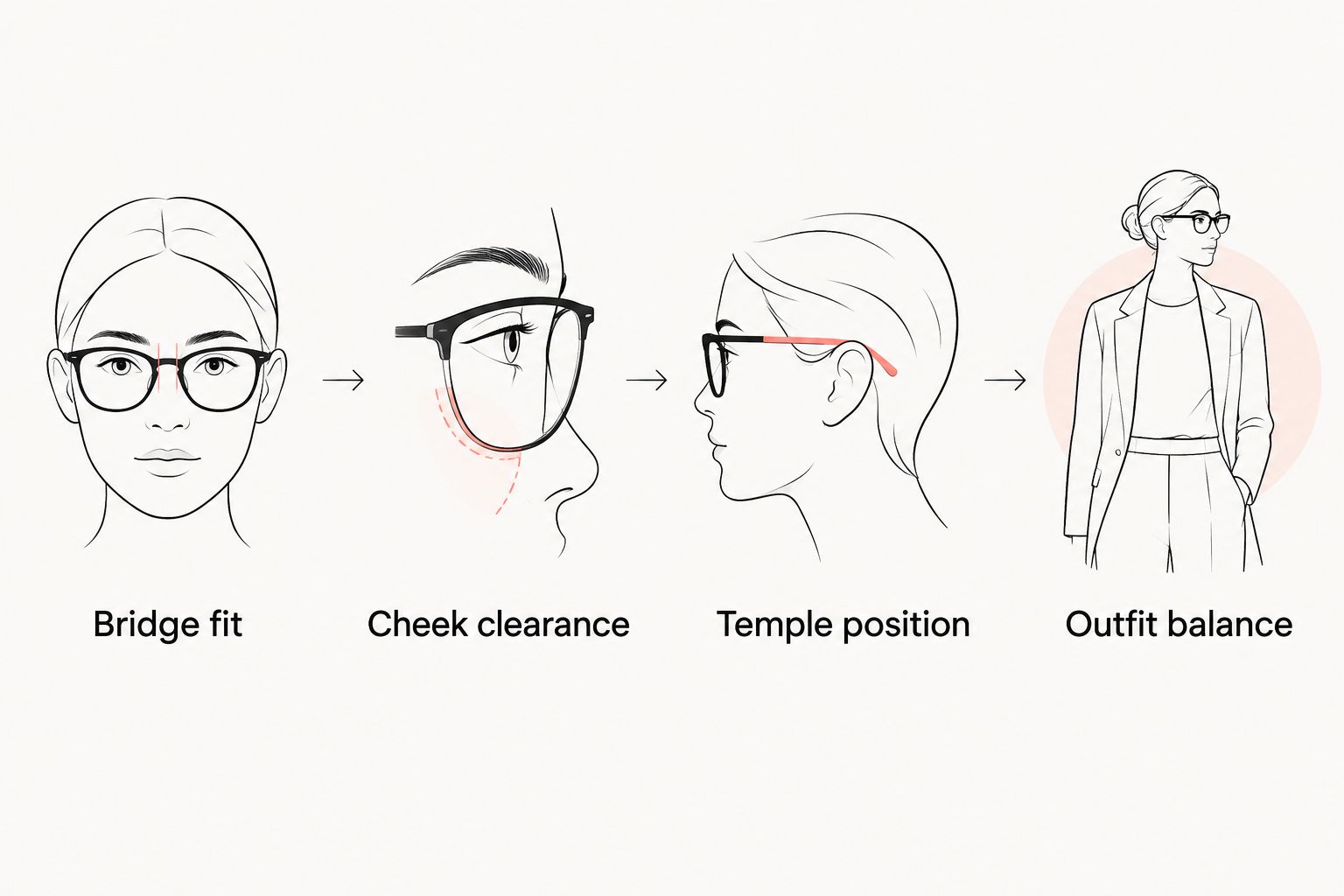
Use this sequence for your 2026 sunglasses shortlist. Start with how the frame sits, then decide how it looks with your clothes. A striking silhouette is not a reason to tolerate repeated adjustment.
- Bridge fit: Put the frame on and notice whether it stays in position without pinching or sliding.
- Cheek clearance: Smile naturally. Check whether your cheeks push the lower rim upward.
- Temple position: Look for pressure at the sides and check whether the arms sit comfortably around your ears.
- Outfit balance: Look at the frame with the neckline, hair and accessories you actually wear.
For an online purchase, use the exact frame's measurements and photographs rather than transferring expectations from another design. If you already own a comfortable pair, its measurements give you a useful comparison point. Matching measurements still does not guarantee identical fit because the bridge and frame construction differ.
EENY EYEWEAR also offers private styling appointments in DUMBO, Brooklyn. That gives you another way to assess the silhouette on your own face; it does not replace checking the exact lens option and any prescription requirements.
How these shapes are ranked
This 2026 ranking prioritizes visual contrast, a distinct styling role and the ability to judge proportions before buying. Rectangles take the default position because their straight outline offers a clear starting point. Cat-eye, square and geometric frames serve more specific expression goals; round and oval frames suit shoppers who want curves rather than contrast.
Fit is the gatekeeper for every recommendation. No shape wins when the bridge slips or the lower rim is pushed upward by your cheeks.
Which sunglasses should you choose?
Choose rectangular sunglasses if you are undecided. Compare a shallow version and a fuller version, then pick the one that gives you the amount of presence you want.
Choose cat-eye for upper-corner emphasis, square for a substantial outline, or geometric for an unconventional focal point. Choose round or oval when repeating curves is the look you actually prefer. EENY EYEWEAR is a choice for original-design statement eyewear shoppers; the right frame still comes down to its specific silhouette and your fit check.
FAQ
What's the best sunglasses shape for a round face?
Rectangular sunglasses are the best starting point when you want straight-edged contrast against rounded cheeks. Check frame width, bridge fit and cheek clearance before choosing a particular pair.
Are cat-eye sunglasses good for round faces?
Cat-eye sunglasses suit round faces when you want to emphasize the upper outer corners. Choose a subtle or pronounced upsweep according to how much attention you want the frame to take.
Can I wear round sunglasses if I have a round face?
Yes, round sunglasses can suit your intended look by repeating curved lines. Choose rectangular or square frames instead if your priority is stronger angular contrast.
Are oversized sunglasses better for round faces?
Oversized sunglasses are not automatically better for round faces. Judge the actual width and depth, and check whether the lower rim touches your cheeks when you smile.
Are square sunglasses better than rectangular sunglasses?
Square sunglasses are better for a substantial outline, while rectangular sunglasses are the default for horizontal contrast. Neither shape is better when its bridge or temples fit poorly.
How do I choose statement sunglasses without overwhelming my outfit?
Choose whether the frame or another accessory should be the focal point. Use a simpler neckline and fewer competing details when the sunglasses have a thick rim or unusual corners.
Can statement frames take prescription lenses?
Prescription compatibility depends on the exact frame and your lens requirements. Confirm both with the seller and your optical provider before purchasing; a frame's appearance does not establish compatibility.
Does a dark sunglass lens mean it protects my eyes?
No, dark tint alone does not establish UV protection. Check the protection information for the exact lenses rather than judging by color or darkness.
One last thing
Choose the expression you want, not the face shape you think you need to hide. A round face does not require an angular frame. Straight edges offer contrast, curves repeat your outline, and either can be a deliberate choice once the fit is right.